
Prepare to lead and shape the future of educational technology and training with a master's degree from the Johns Hopkins Learning Design and Technology program.
Program Overview
This 30-credit, fully online program is designed for professionals who want to go beyond applying best practices — understanding why they work, when they don’t, and how to lead organizations toward better learning outcomes. Grounded in rigorous evidence, practical craft, and hands-on experience with the latest digital tools, the program reflects the convergence of instructional design, learning engineering, AI, and educational technology into a discipline that demands more than any single field can offer on its own.
Concentrations
Three concentrations define the program's scope. Across all three concentrations, the program is built around the same commitments: evidence-based decision-making, iterative design, and the capacity to lead in environments where learning and performance matter.
-
Learning Experience Design
Prepares you to design, prototype, and evaluate learning experiences grounded in the learning sciences — and to lead design strategy across education, business, government, and nonprofit contexts.

-
Learning Engineering for Next-Generation Systems
Prepares professionals in defense, healthcare, and large-scale organizations to apply engineering discipline and analytics to human performance — treating capability development as a design-and-measurement challenge with real operational consequences.

-
Artificial Intelligence Leadership in Education
Prepares current and aspiring leaders to adopt and govern AI responsibly — building the technical fluency and judgment needed to make consequential decisions that align with institutional values, ethical frameworks, and stakeholder trust.

-

Learning Experience Design
Prepares you to design, prototype, and evaluate learning experiences grounded in the learning sciences — and to lead design strategy across education, business, government, and nonprofit contexts.
Learning Engineering for Next-Generation Systems
Prepares professionals in defense, healthcare, and large-scale organizations to apply engineering discipline and analytics to human performance — treating capability development as a design-and-measurement challenge with real operational consequences.
Artificial Intelligence Leadership in Education
Prepares current and aspiring leaders to adopt and govern AI responsibly — building the technical fluency and judgment needed to make consequential decisions that align with institutional values, ethical frameworks, and stakeholder trust.
Upcoming Admissions Events
Have questions about our degree programs, the application, or financial aid and costs? Join us for an inside look at a graduate experience defined by innovation and driven by evidence-based research. Learn more about your area of interest or career path, meet some of our faculty, and connect to the Johns Hopkins School of Education community. Check out our admissions events and register for a virtual information session today.

Comprehensive Preparation
-

Interdisciplinary Foundation
You will build a strong foundation in principles and practices from the learning sciences, combined with research methods, to design effective, evidence-based learning environments and pedagogies. This interdisciplinary approach integrates insights from psychology, education, and design, equipping you to address complex challenges in learning and technology in K–12, higher education, industry, and informal learning settings.
-

Real-World Application
Across courses you will collaborate with your peers to design technology-supported educational solutions while being encouraged to reflect critically on the social, political, and ethical implications of their your work. An optional internship will give you opportunities to earn credit and expand your professional network while you build skills in real-world workplaces.
-

EdTech with Ethics
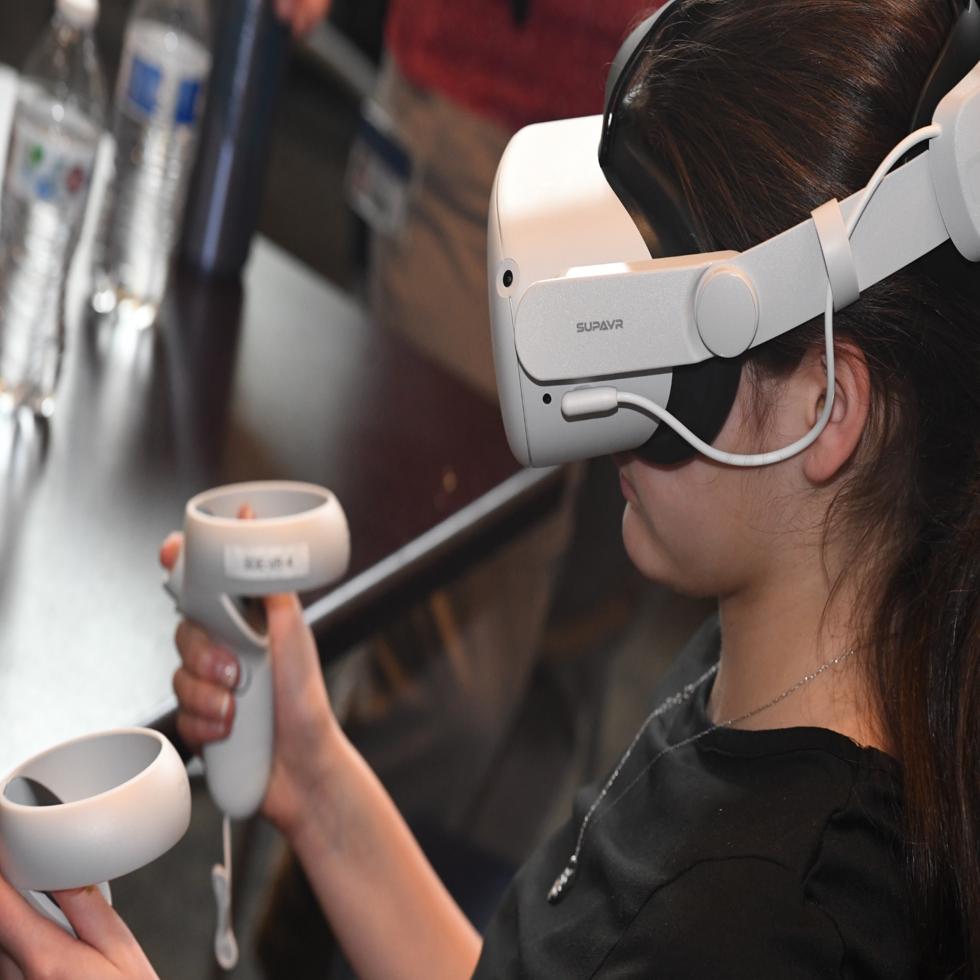
You will investigate the affordances of new technologies such as AI and extended reality (XR) while weighing ethical considerations and ensuring that designs are human-centered in their application.
-

Equity and Inclusion
The program equips you with the skills and knowledge to create educational experiences that promote equity and inclusion. You will learn to design inclusive, accessible learning environments and to consider the needs of marginalized populations.
Learning Technology Alum Makes Forbes 30 Under 30
Thomas Thompson earned his Master of Science in Education from the Johns Hopkins School of Education in 2023. He has since cofounded Eduaide.Ai, an instructional design platform built by teachers, for teachers.
“"It was through the process of writing my thesis that I was able to think not about technology and education from a theoretical or research perspective, but in terms of what building different platforms or technologies to support teachers would actually look like."

“"It was through the process of writing my thesis that I was able to think not about technology and education from a theoretical or research perspective, but in terms of what building different platforms or technologies to support teachers would actually look like."
Career Paths After SOE
Over the next five years, the Bureau of Labor Statistics projects 6% job growth for instructional designers in education and government, and 9% growth for training and development specialists in private industry.
$74,620 Instructional Coordinators Median Annual Salary
Industries: Professional, scientific, and technical services, real estate, and government sectors
$68,660 Educational Technology Specialists Median Annual Salary
Top Paying Regions: San Francisco, New York City, Washington, D.C.
$74,620 Instructional Coordinators Median Annual Salary
Industries: Professional, scientific, and technical services, real estate, and government sectors
$68,660 Educational Technology Specialists Median Annual Salary
Top Paying Regions: San Francisco, New York City, Washington, D.C.
People of SOE
James Diamond, PhD
Assistant Professor; Director, Master of Education in Learning Design and Technology Program
“The future of education will depend on educational technology leadership. We train leaders who can critically assess emerging tools, navigate social impacts, and design inclusive, human-centered solutions that work."

Dr. James Diamond uses design-based research methods to create and study technologies that foster the agency of individual learners in real-world settings. He has extensive experience in educational research, design, and evaluation, with areas of interest ranging from social studies and civics education to STEM literacy and computational thinking. His research has been funded by the National Science Foundation, the MacArthur Foundation, and the Gates Foundation, among others.

Legal Disclosure
Master of Education in Learning Design and Technology
Students should be aware of additional state-specific information for online programs.